Did you know there are an estimated 20,000 different kinds of bees?! Divided into seven distinct families, bees are also categorized by proboscis (or tongue) length into three groups:
Short-Tongue Bees:
- Andrenidae, or mining bees – with wasp-like features and advanced eyes.
- Colletidae, or: plasterer, masked, yellow-faced or polyester bees – with unique two-part tongues.
- Stenotritidae – the smallest family, unique to Australia.
Medium-Tongue Bees:
- Melittidae – a primitive family of specialist foragers.
- Halictidae, or sweat bees – small, colourful and social.
Long-Tongue Bees:
- Apidae, or cuckoo, carpenter, digger, bumble, stingless or honey bees – the largest family, found worldwide.
- Megachilidae, leaf-cutter, mason, orchard or carder bees – all named for the materials used to build their nests.
You can learn more about them over at Best Bees.
Of the ~20,000 species, only 7 of them are honey bees!
And, though honey bees are probably what most of us are familiar with (apis mellifera), none of them are native to Canada, nor do they live wild in Canada. Any time you spot a honey bee, know that it belongs to a kept hive somewhere nearby.
On the other hand, Canada is home to around 800 different species of bees, and about 500 of them are found around BC. 450 are native to the province, meaning that they are found naturally in this geographic region (as opposed to having been introduced by Europeans or otherwise).
“My” Bees
Early in starting my garden, I knew that bees would be a major focus for me. I’ll admit – I had hoped this meant I’d keep my own honey bees at some point (and I still might one day!). By the end of my first season though, I could see that the honey bees were already reigning supreme over my blooms. Right up into fall, the majority of bees foraging in my garden were western honey bees, and it was about this time that I also learned keeping bees is not an act of conservation. Though honey bees are necessary to support the existing scale of our agriculture industry, honey bees compete with our native bees – bees at real risk of extinction.
“High densities of honey bee colonies increase competition between native pollinators for forage, putting even more pressure on the wild species that are already in decline. Honey bees are extreme generalist foragers and monopolize floral resources, thus leading to exploitative competition—that is, where one species uses up a resource, not leaving enough to go around.”
Alison Mcafee, for Scientific American
Don’t worry, I’m not suddenly anti-honey-bee! But, armed with the research I was doing at the time (on biodiversity, food systems, and the value of Traditional Ecological Knowledge), I did change my mind about how best to “keep my bees”. Since I can rest assured that any honey bees I see around my garden are already being protected and cared for by someone, somewhere, in a managed hive, I have simply decided to turn my attention to supporting the rest – to the especially brave ones that spend winters underground, to the jewel-toned and iridescent ones, to the big bumbly ones, and to the ones that many of you have yet to formally meet…
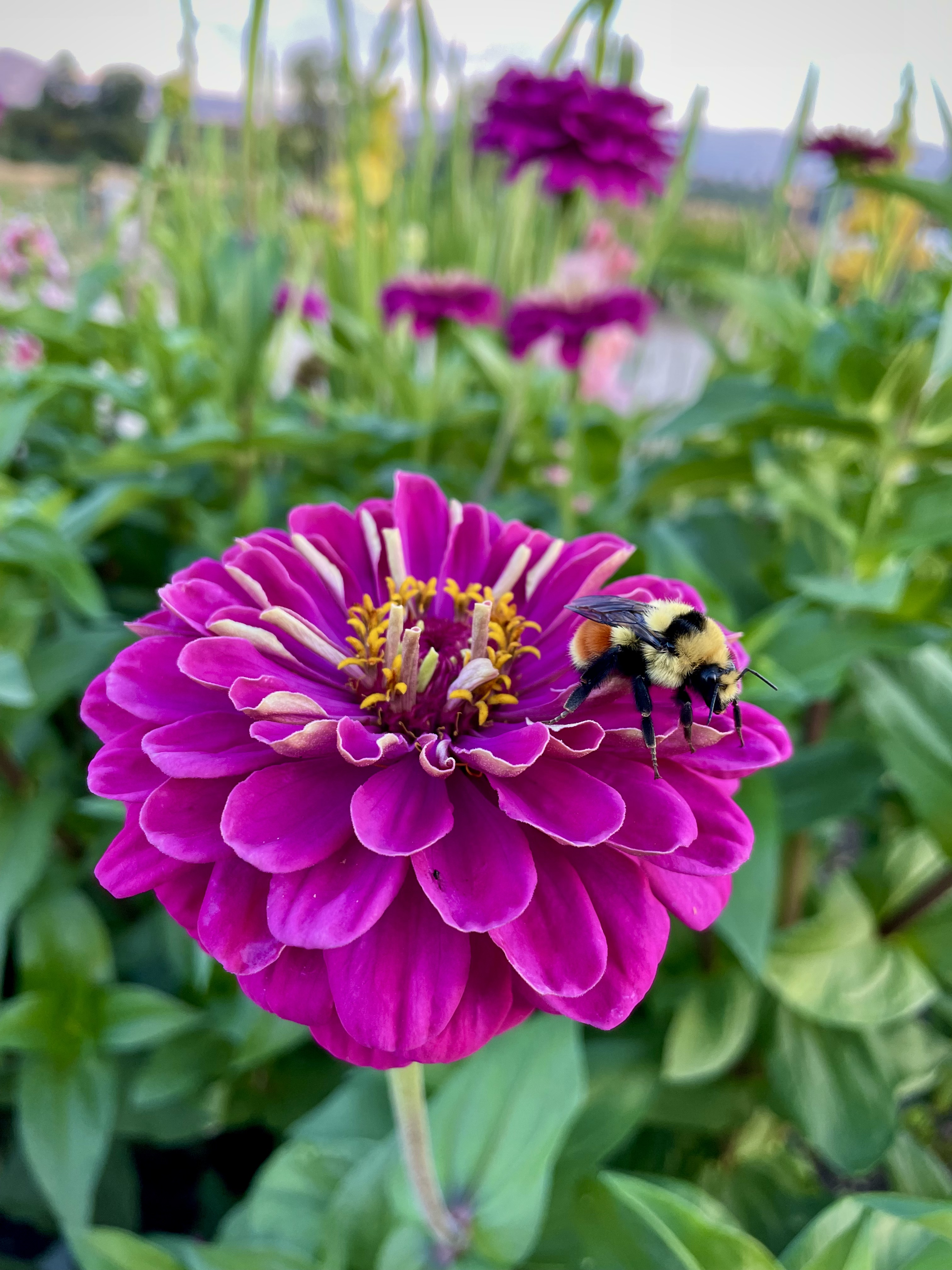
Hunt’s Bumble Bee on a Benary Zinnia (above)
Bombus huntii, native to western North America, from western Canada as far south as the Trans-Mexican Volcanic Belt.
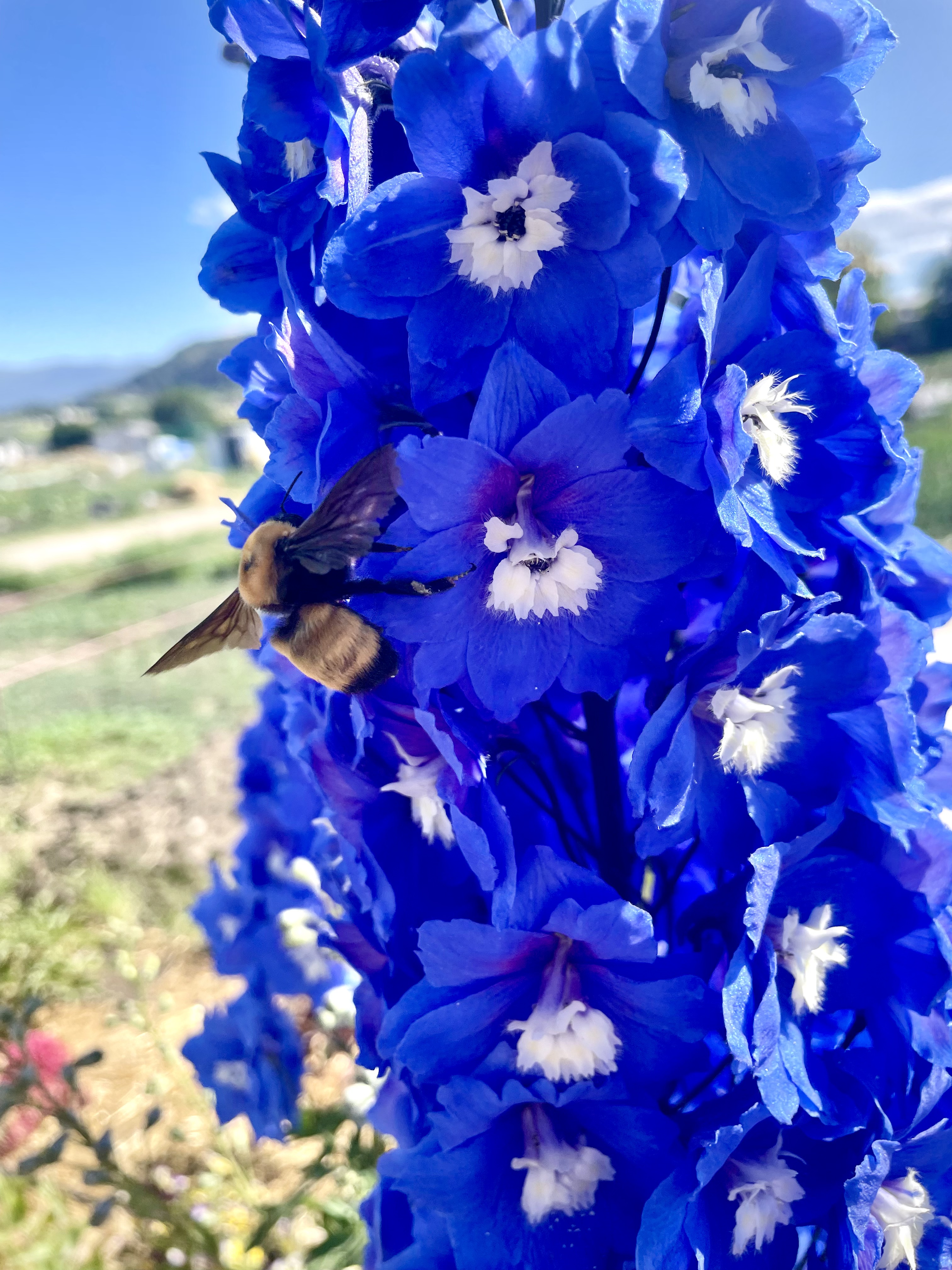
Nevada Bumble Bee on a blue Delphinium (below)
Bombus nevadensis, a native North American bumble bee, occurring from Alaska to California in the west, east to Wisconsin, and in Arizona, New Mexico and Mexico.
The Bumbly Ones
About 250 of the ~20k bee species are bumble bees, and these gravity-defying busy-bodies are arguably my favourite. I love watching them squeeze themselves into tubular blooms! Bumbles are generalist foragers, meaning they aren’t very fussy about what they eat, however, some plant species rely on bumble bees specifically to aid in their reproductive success. They live an annual life – emerging for the first time in spring (as early as February), and dying at the end of the season (as late as November); only fertilized queens will survive winter by burrowing underground, or hibernating in hollow trees, empty bird nests, and rock walls.
Growing For the Bees
Given the length of their season, and the urgency to prepare before winter, early and late season resources are critical for bumble bees. This is one of the ways that I try to support my garden’s bees – it’s not too hard to keep my cosmos blooming right up to the night of our first hard frost, so my number one challenge has been planting and starting early-bloomers. Spring bulbs and tubers have been fantastic for this! Tulips, crocus, daffodils, hyacinths, early irises, – there are so many great options. Hardy shrubs often bloom early as well, given their already well-established root systems, and so do many of my low-lying ever-green plants: spring creeping phlox (phlox rubulata ‘spring white’, ’emerald cushion blue’), creeping thymes (thymus vulgaris, thymus serpyllum ‘elfin’), morning star sea thrift (armeria maritima ‘deep rose’), turkish veronica speedwell (veronica liwanensis), prairie smoke (geum trifolium), lewisia (lewisia longipetala), and even cold-tolerant violas.
This year, I’ve added coral bells (heuchera cylindrica), lenten rose (helleborus spp.), a native pasque flower (pulsatilla rubra), smoky hills skullcap (scutellaria resinosa), and I’m greatly expanding my collection of yarrows (achillea millefolium, ‘colorado mix’, ‘strawberry seduction’, ‘terra cotta’, achillea ptarmica ‘double diamond’) to bridge over the month of June with my delphiniums (delphinium elatum) and planted annuals.
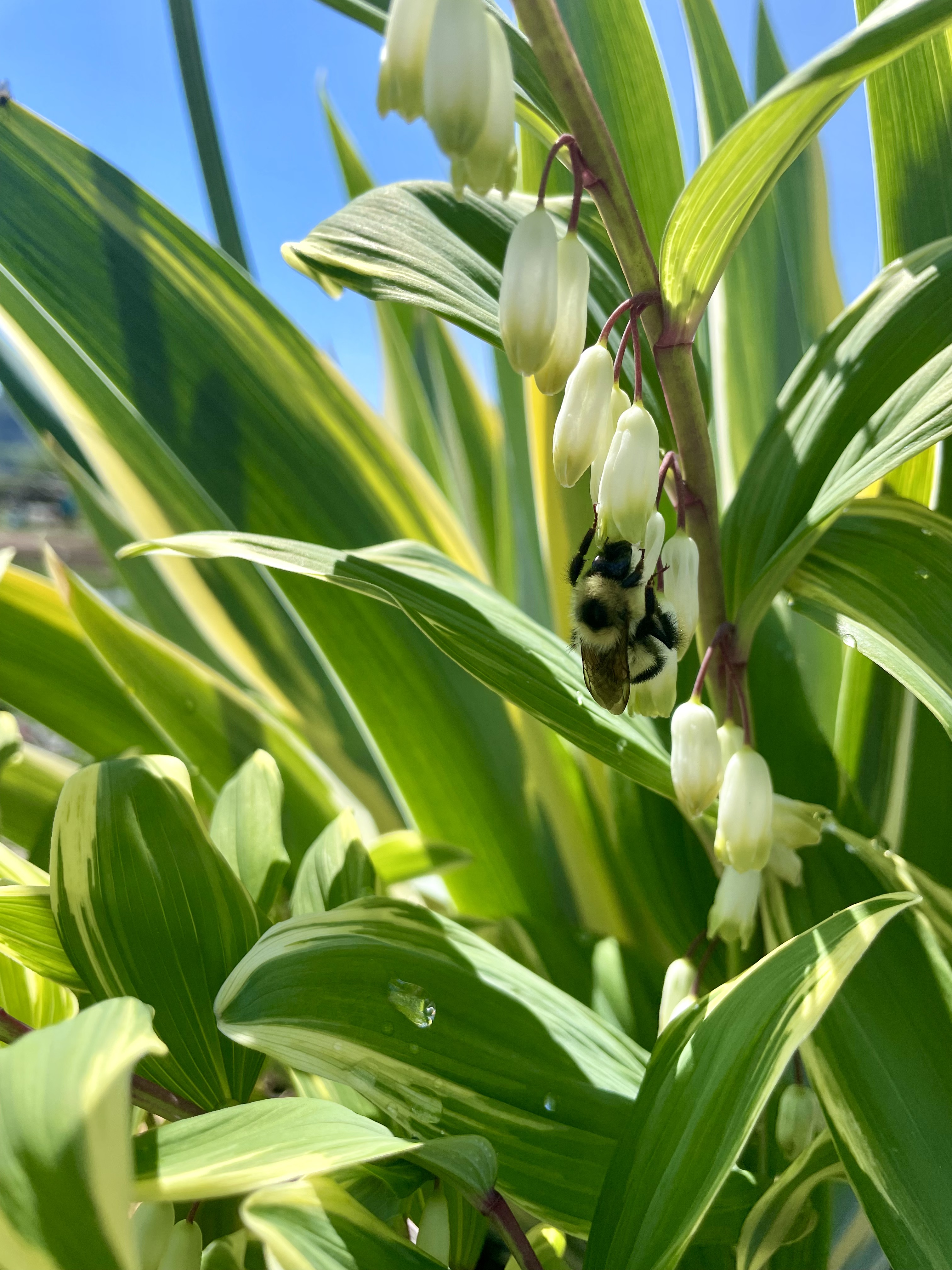
Bumble Bee on Solomon’s Seal (polygonatum odoratum; above).
Still to be ID’ed. Observed May 11th, 2024.
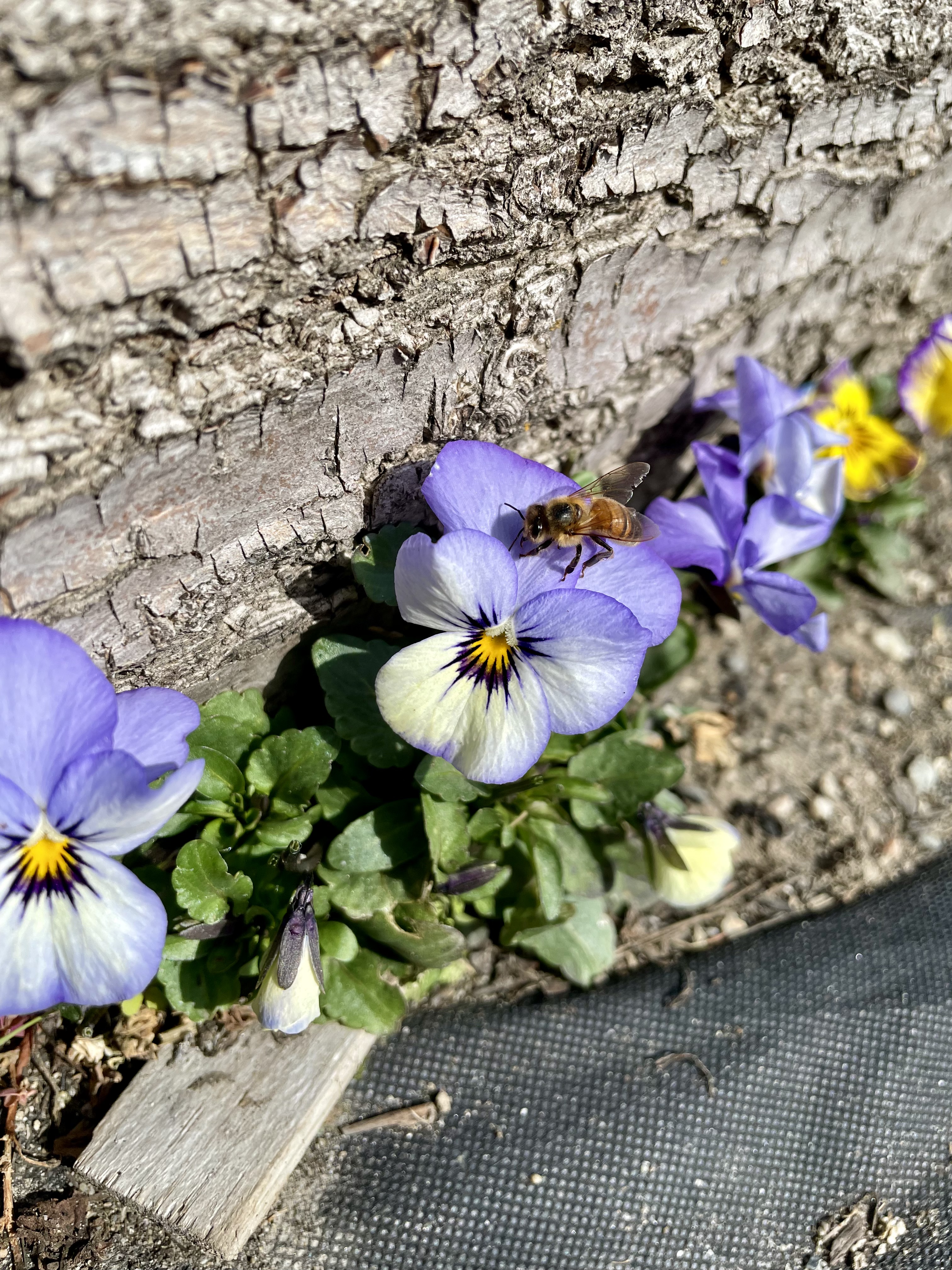
Western Honey Bee (apis mellifera) on a viola bloom (below).
Observed March 14th, 2024. These violas had self-seeded late in the season, and celebrated the warm south sun all winter long here! Naturally, this was where I saw the first bee in my garden for the season.
Stewarding the Bees
Since I’m not investing in honey hives any time soon, I have happily come across one way that I can sorta-keep bees in my garden. I had the privilege of releasing a few dozen native blue orchard mason bees (osmia lignaria) in my garden this year! The trick with these darlings is pretty simple – they need holes to nest in, and mud to pack it up tight with.
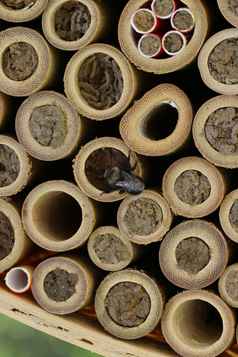
This photo here from Backyard Beekeeping shows a variety of different sized holes created in cut bamboo canes. Different kinds of bees prefer different hole diameters and cane lengths, and pack them with various materials. It’s best to place these in several different areas of your yard or garden, since placing them all in a single location risks exposing all nesting bees to various mites, disease, or accidents.
Mason bees are biologically clever enough to lay the eggs of their female offspring first, each one in their own cell, separated by packed mud. The deeper they are in the nesting tubes, the safer they are from predators. They pack male offspring into cells after, because females are also reproductively more important than the males. Only the viable, most resilient males will survive to reproduce.
Each egg is secured in the tube with a small cache of pollen and nectar, foraged by the nesting female, providing ample food for hatching larvae. Larvae grow, poop and molt, then spin themselves into silk cocoons. These cocoons can be removed from nesting tubes at the end of the season, cleaned and stored cold until spring. The benefits of this is that cocoons are more safe in your refrigerator than they might be in your garden – where they can be susceptible to increasingly-present predators. But it’s not always necessary in your area. If you’re interested in stewarding your native mason bees, I encourage you to do a little research on the risks they face, and what you can do to ensure optimal survival.
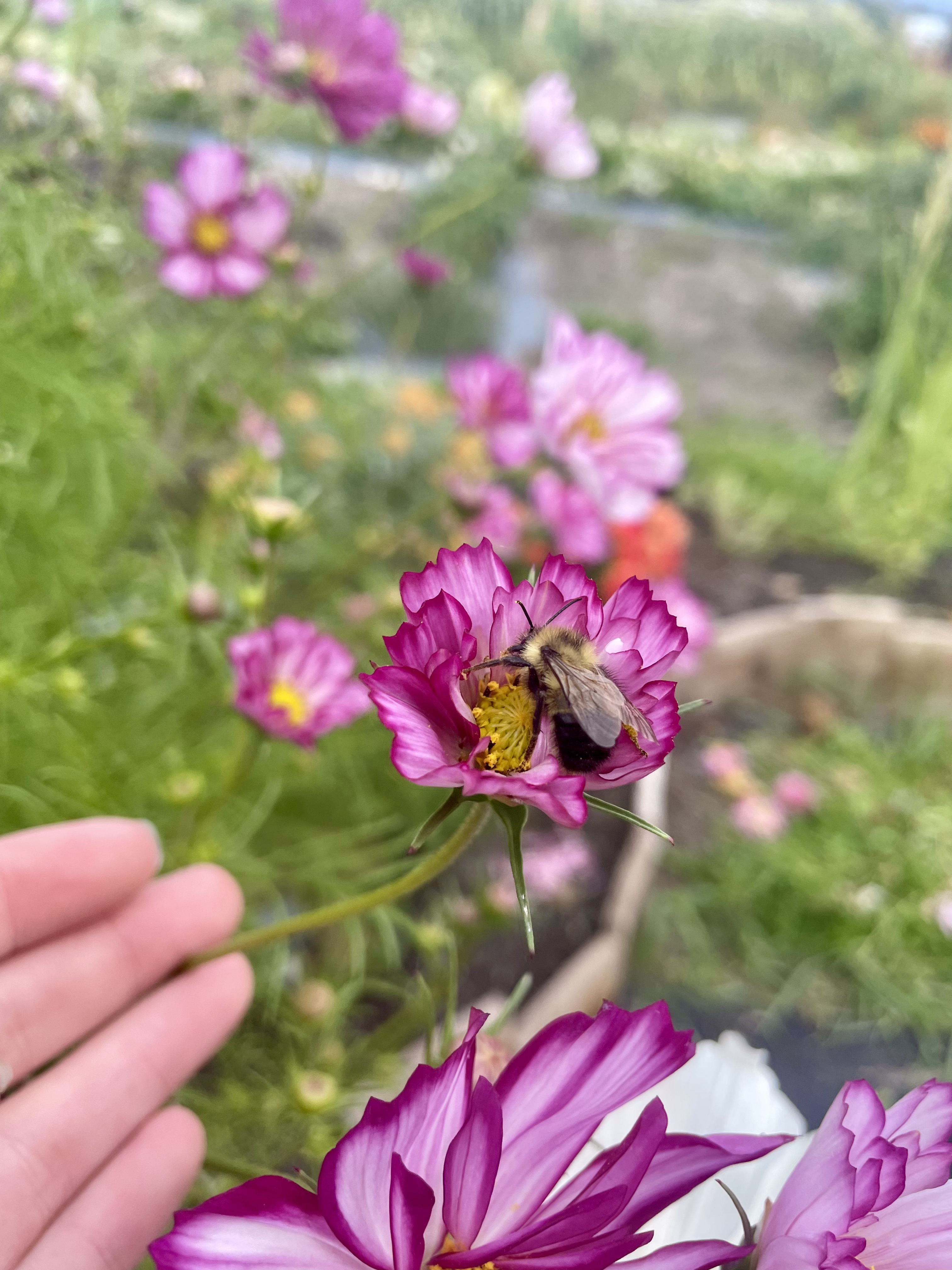
Half-Black Bumble Bee on a Cosmo (above).
Bombus vagans, a relatively small bumble bee with wide distribution across North America.
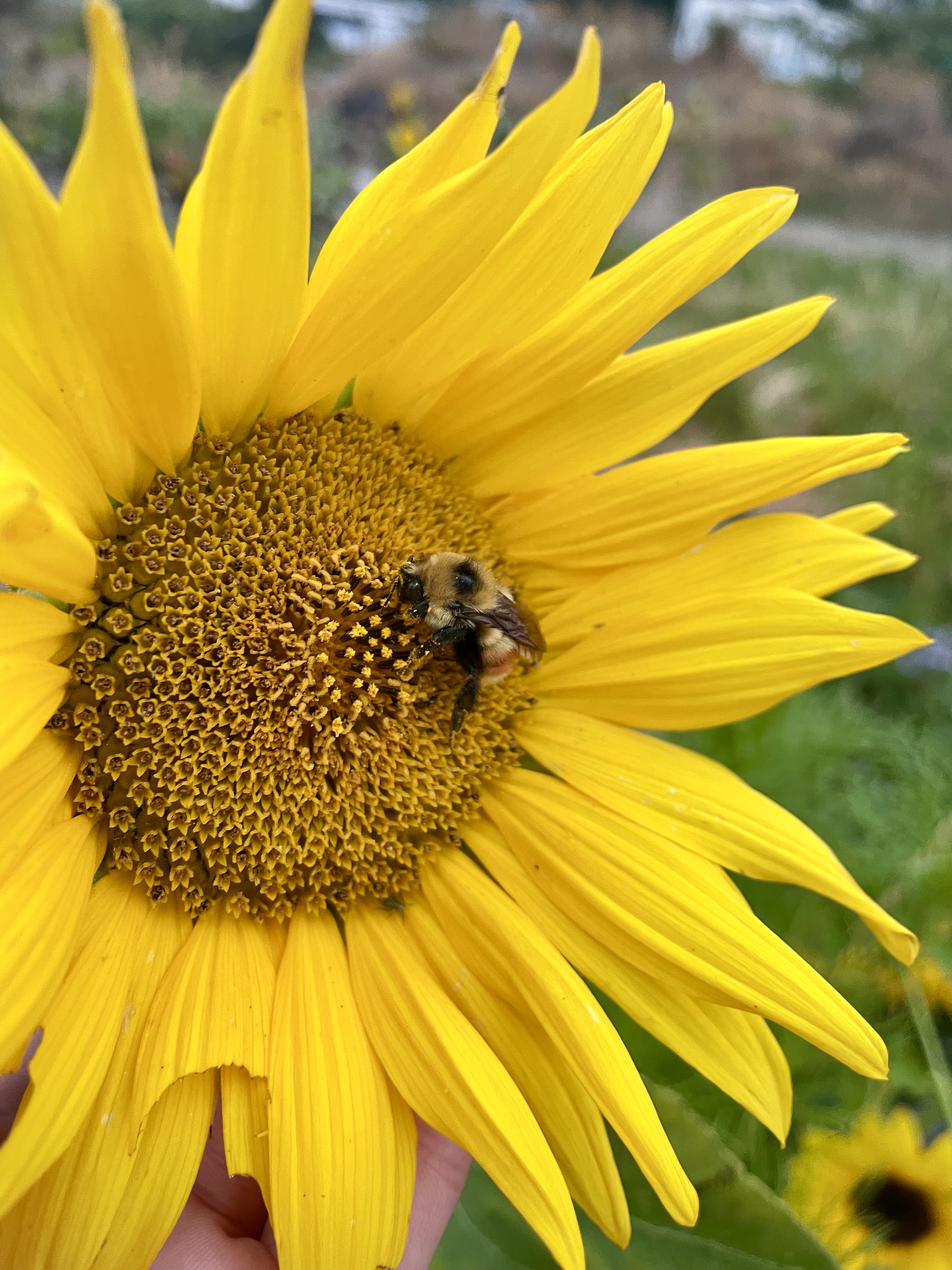
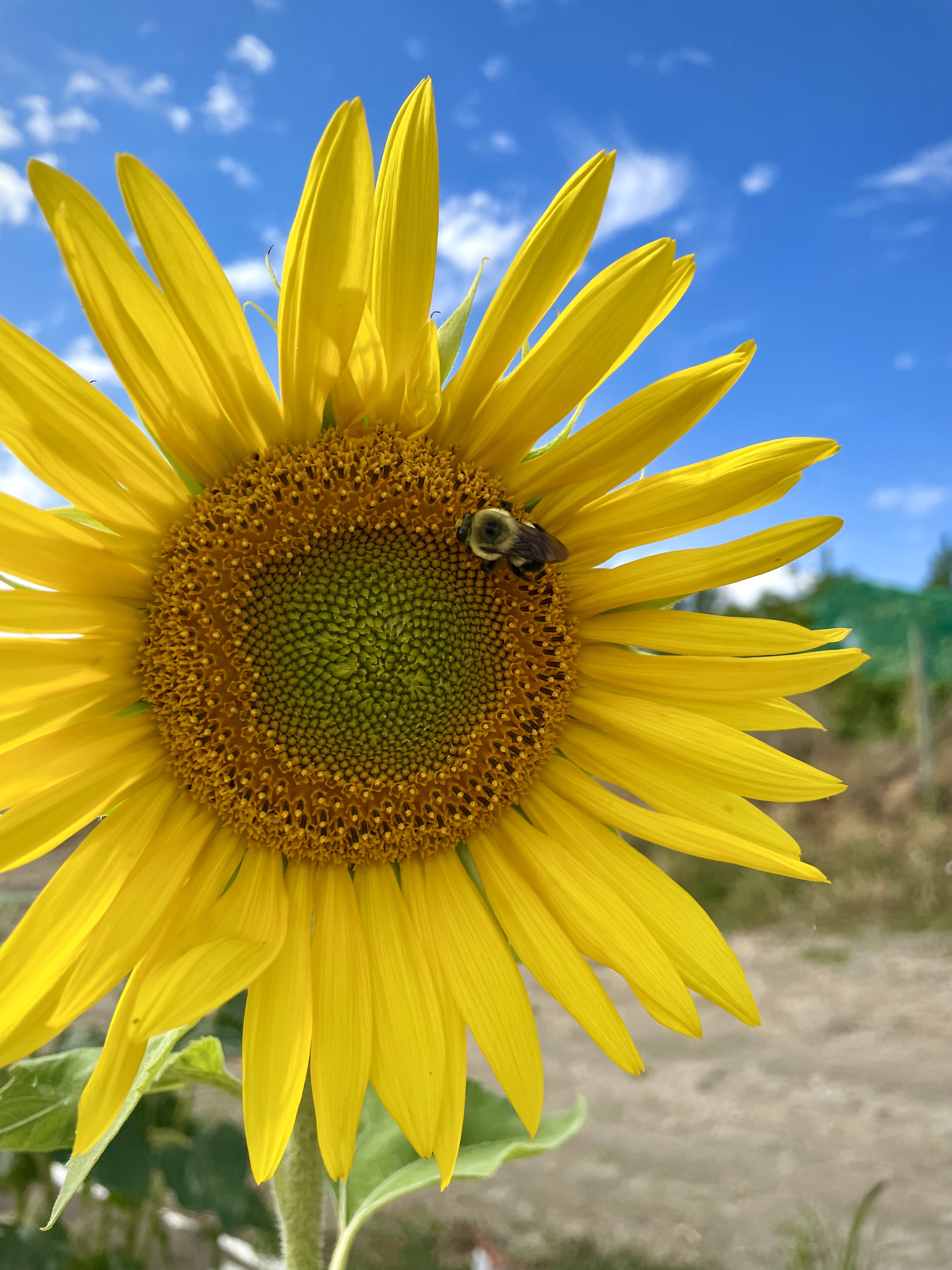
Brown-Belted Bumble Bee on a Sunflower (below).
Bombus griseocollis, native to much of the US except for the southwest, and the southern-most regions of Canada.
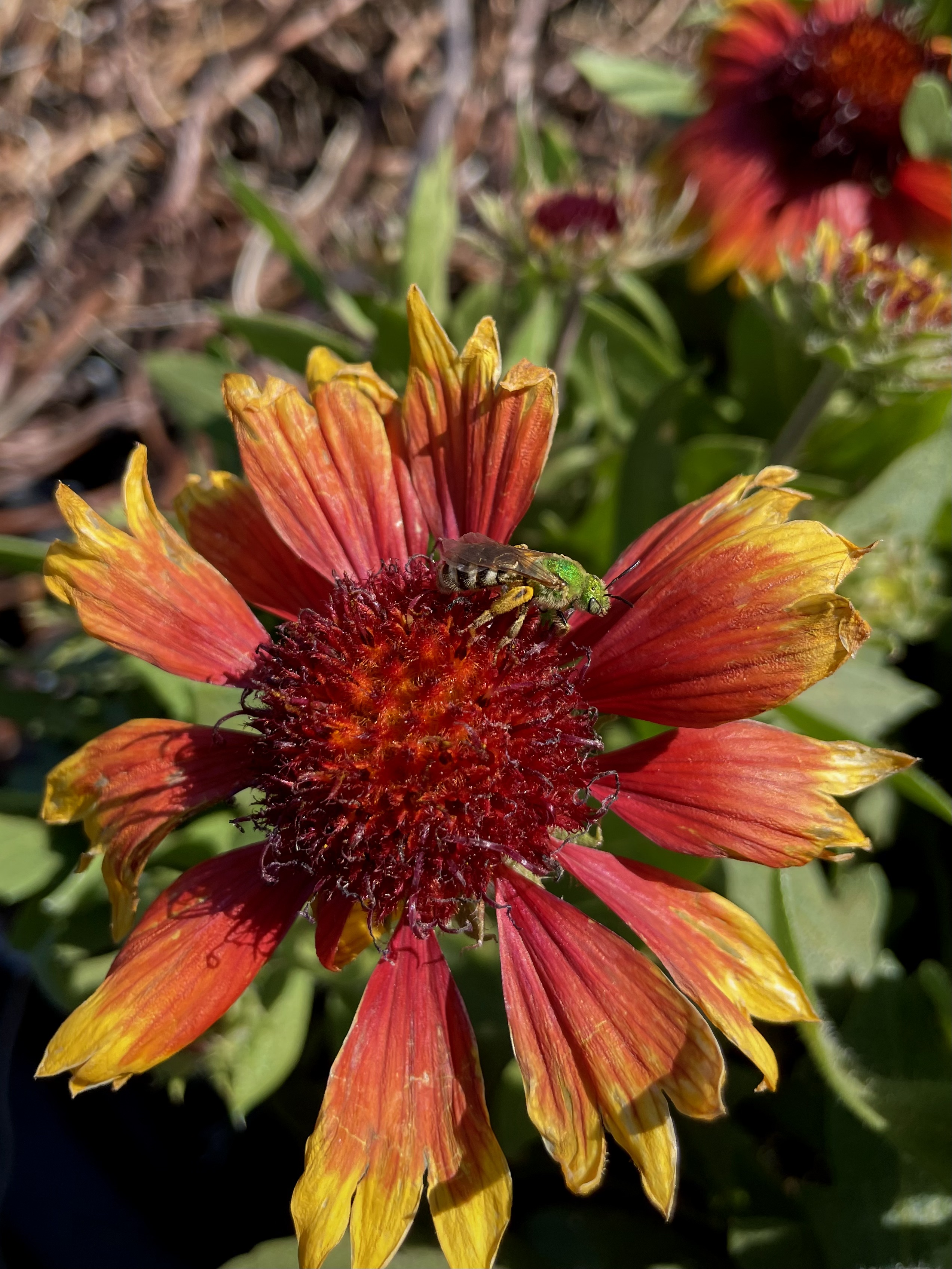
Bicolored Striped Sweat Bee on a fading Blanket Flower (above).
Agapostemon virescens, of the Halictidae family, native to much of North America.
How do I know which bees are which?
Well, I’m learning! And I’ve had a lot of help along the way. One of the best ways that I’ve found is to use iNaturalist. I have the (free) app on my phone – I upload photos that I take in my garden, and other, more qualified folks, offer their identifications. Once their identity has been confirmed, your observations can even be used for research purposes, tracking different species across the globe. You can use it to identify and track all kinds of insects, plants, and birds. It’s a great resource!
Want to save the bees?
The Xerces Society (for Invertebrate Conservation) says “focus on habitat, not honey bees”. Xerces is another fantastic resource for learning about native bees – I highly recommend it!